How to Improve Employee Accountability at Work
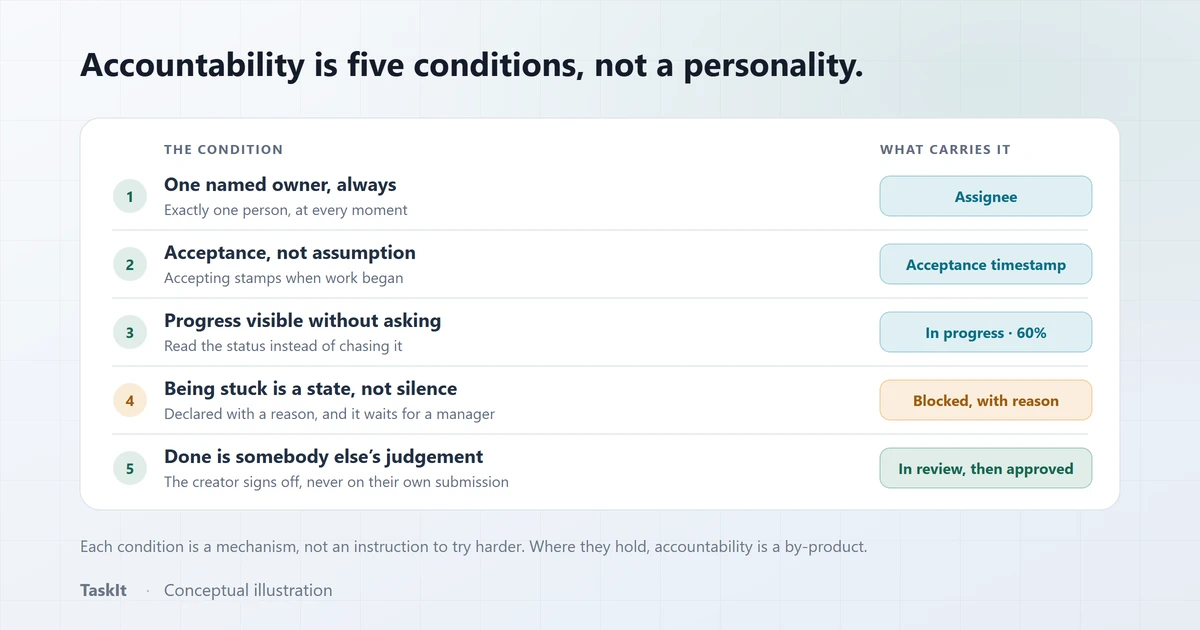
Accountability improves when five conditions are true: work has one named owner, the owner has explicitly taken it on, progress is visible without anyone being asked, being stuck is a recorded state rather than silence, and completion is confirmed by somebody other than the person who did the work. Where those five hold, accountability is a by-product. Where they do not, no amount of managerial pressure produces it.
In this article
Why "hold people accountable" does not work as an instruction
Because it is a demand for an outcome without any of the mechanics that produce it. In practice it means "chase harder", which produces resentment and no information.
Almost every accountability problem presented as a people problem turns out, on inspection, to be a structural one. The work was never assigned to a specific person. The person never confirmed they had it. Nobody could see it was stuck. Or "done" was something the person doing the work declared about their own work.
The three most common failure patterns look like this:
- Diffused ownership. A request made to a group is owned by nobody. When it is missed, the conversation becomes about attitude rather than about a process gap that was always going to produce this.
- Invisible blockage. Somebody has been waiting on a supplier for four days. From outside, that is indistinguishable from not having started — so they are treated as if they had not.
- Retrospective blame. The problem surfaces weeks later, when the only available response is to attribute it. Nobody learns anything, and whoever happened to be holding the work absorbs it.
The cost of getting this wrong
Condition one: one named owner, always
Not a team, not a group chat, not "whoever is free". Exactly one person, identifiable at any moment, including after the work has changed hands.
This is the condition everything else rests on, and it is the one most often broken by accident. Work mentioned in a meeting, posted in a channel or raised as "can someone look at this" has no owner, and adding urgency to it does not create one.
The nuance is that you do not always know who the owner should be — and pretending otherwise leads to work being assigned to whoever the manager thought of first, who is usually whoever is already busiest. The right answer is to raise it for a team in a way that one person can claim exclusively, so it goes from unowned to owned in a single recorded step rather than sitting in ambiguity. Department task management is that mechanism.
Condition two: acceptance, not assumption
Assigning work is a claim about intent. Acceptance is evidence that it landed. The gap between the two is where a surprising amount of missed work lives.
A task can be assigned and simply not noticed. Without an explicit acceptance step, the manager believes it is underway and the employee has not seen it, and both discover the truth at the deadline. That is not an accountability failure by anybody — it is a missing handshake.
Acceptance also produces the single most useful measurement in most teams: the time between raising work and someone taking it on. A long acceptance time is almost never a performance problem; it is a routing or notification problem, and treating it as the former is how a manager damages a team that is working perfectly well.
How TaskIt does this
Condition three: progress visible without asking
If the only way to find out how something is going is to ask, then accountability costs a manager’s attention and an employee’s interruption every single time.
Chasing is the manual substitute for a status field. It scales linearly with headcount, it produces an estimate rather than a fact, and it has to be repeated tomorrow. It also carries a message the manager rarely intends: that they expected the work not to be done.
Visibility replaces that with reading. A status, a progress figure, a due date and an activity trail answer the question before it is asked — and, importantly, they answer it for the employee too. Being able to see that your own work is visible and on track removes a low-level anxiety that is easy to underestimate.
Condition four: being stuck must be a state, not silence
This is the condition that separates accountability from blame, and the one most systems leave out entirely.
People get stuck for reasons that are usually not theirs: a customer has not replied, an approval is outstanding, a part has not arrived, another team has not finished their bit. In a system with no way to say so, all of those look identical to not having started.
Give people a way to declare it and two things change. The problem reaches whoever can actually solve it, days earlier. And the person who is stuck stops being accountable for something outside their control — which is the single biggest driver of whether a team believes accountability is fair.
- The reason is recorded, so a pattern is visible across many tasks rather than only in one conversation.
- The work appears on a manager’s attention queue instead of sitting silently until the due date.
- Repeated reasons — the same supplier, the same approval — turn into a process fix rather than a performance conversation.
In TaskIt this is the Unable to Complete flow: the assignee marks the task blocked with a reason from a predefined list or their own wording, and it waits for a manager to reassign, resume or cancel it.
Condition five: done is somebody else’s judgement
Self-declared completion is the most common source of rework in any team, and it is entirely avoidable.
If the person who did the work is the person who decides it is finished, then "completed" means "somebody said so". That is fine for low-stakes work and corrosive for anything a customer sees, anything with a cost attached, and anything that has to be right the first time.
A review step does not have to be heavy. It needs to be somebody other than the submitter, and it needs to be recorded. In TaskIt the reviewer is the task’s creator or anyone with the review permission, and a creator who is also the current assignee is refused unless their role holds the review permission. Because reviewing — and completing a task directly — are permissions on the role, keeping approval away from the person who did the work is something you set up rather than something to assume. A rejection returns the task on the same ID, so the second attempt sits in the same history as the first. An admin can also let employees complete tasks they assigned to themselves without review; that setting is off by default.
Accountability across a handover
The moment work changes hands is where accountability is most often lost — and where recording it pays back most.
When a job is reassigned with nothing more than a change of name, everything the previous person knew and did evaporates. The incoming person inherits both the work and the appearance of having been slow, because the elapsed time now reads as theirs.
A recorded transfer fixes both halves. It states what was completed and what is pending, so nothing is repeated or assumed; and it stamps the progress figure at the moment of transfer, so a jump or a drop afterwards is attributable to whoever caused it. The task handover process works through what has to move with the work.
Using the record without turning it into surveillance
The difference is what is recorded. Events that happened to the work are legitimate. Measurements of a person at their desk are a different thing entirely.
Everything above produces a record as a by-product of doing the work: acceptance timestamps, progress updates, handovers, blocked reasons, review decisions. That record is what makes accountability possible without anyone being chased. It is also, handled badly, what makes a team feel watched.
Four practical rules keep it on the right side:
- Say what you look at, before you look at it. Measuring something nobody knew was being measured is how people end up penalised for behaviour nobody asked them to change.
- Show the working. A figure someone can trace back to specific tasks invites a correction. A score cannot be corrected, only resented.
- Ask about outliers, not averages. The three slowest jobs of the month usually contain the actual finding, and it is usually structural.
- Never measure presence. Timers, timesheets, screen capture and idle detection measure how busy someone looks, which is a skill of no value to anyone. TaskIt deliberately has none of them.
How to track employee productivity goes further into which measurements are worth trusting and which distort the work they measure.
Frequently asked questions
That each piece of work has a named owner who has taken it on, whose progress is visible, who can declare when they are stuck, and whose completed work is confirmed by somebody else. Where those conditions hold, accountability is a by-product of how work runs rather than something a manager has to enforce.
Because it asks for an outcome without providing the mechanics. Most accountability failures are structural — work was never assigned to a specific person, nobody confirmed they had it, or being stuck was indistinguishable from not starting. Pressure applied on top of those conditions is experienced as blame and makes people less willing to take work on.
You do not, and that is the point. When someone can record that they are stuck and why, the accountability moves to whoever can unblock it — usually not the assignee. A team that believes blocked work is handled fairly reports problems days earlier, which is where most of the benefit comes from.
It should not be. Recording what happened to the work — accepted, progressed, handed over, blocked, reviewed — uses events that were worth recording anyway. Screen capture, keystroke logging and idle detection measure presence instead, and tend to teach people to look busy rather than to be effective.
With ownership and acceptance. Make sure every piece of work is addressed to one person or claimable by one person, and that taking it on is an explicit action. Those two alone remove most of the ambiguity that later gets described as an accountability problem.
Written by
Esha Mehta
All articles by Esha MehtaRelated reading
Articles and pages that cover the next question this one raises.

Why Businesses Need an Audit Trail for Task Management
The difference between an activity feed and an audit log, the questions each one answers, and why partial coverage should always be stated rather than implied.
Read article
Task Handover Process: How to Transfer Work Without Losing Context
The difference between a handover and a reassignment, the five things that must move with the work, and a process that survives leave, shift changes and blocked tasks.
Read article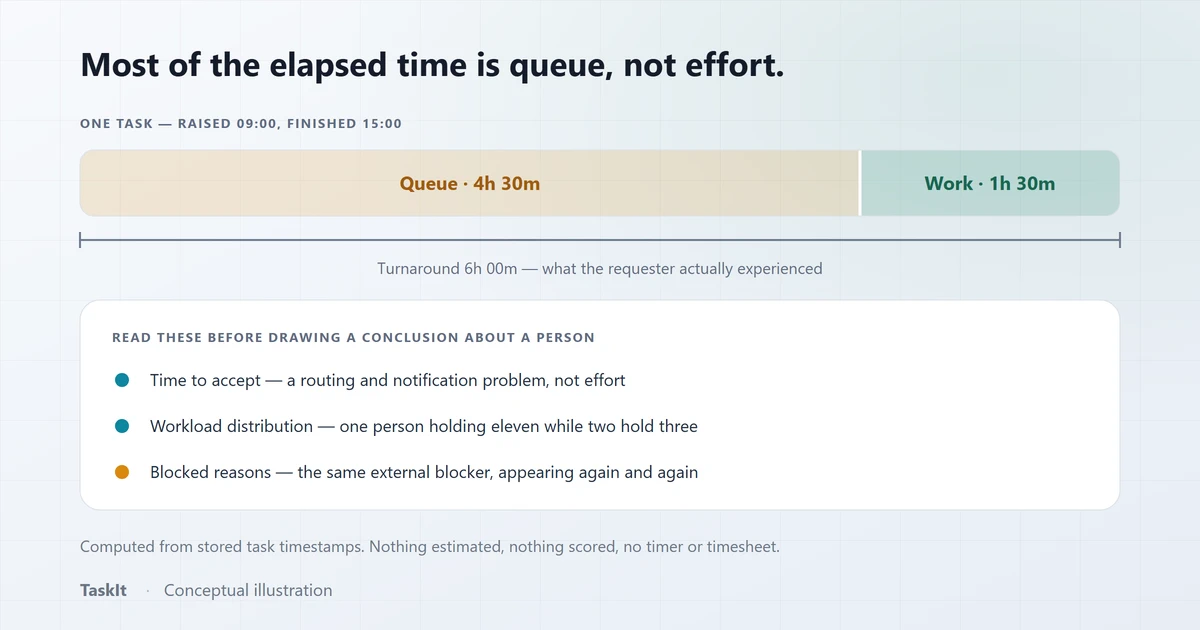
How to Track Employee Productivity Without Distorting It
Most productivity problems turn out to be queueing problems. How to tell the difference before having a conversation about anyone’s performance.
Read articleEmployee accountability with TaskIt
The five conditions above, mapped onto what the product actually does.
OpenAudit logs
The append-only record behind every question about what happened.
OpenWorkflow management
The lifecycle that makes acceptance, blocking and review real steps.
OpenSee how it works on your own tasks
Every capability described above is available during the 30-day free trial.