How to Track Employee Productivity Without Distorting It
Track productivity for task-based work using measurements derived from events the system already records — how long work waits before someone takes it on, how long it takes once started, and how long the requester waited in total. Compare those three before drawing any conclusion about a person, because in most teams the largest slice of elapsed time is queueing, and no amount of pressure on people shortens a queue.
In this article
The mistake almost everyone makes first
Measuring activity instead of outcomes. Activity is easy to count, easy to produce on demand, and tells you almost nothing.
The first productivity metric a team adopts is usually task count, hours logged, or messages sent. All three share a flaw: a person can increase them within a week without doing any more useful work, and once they realise that, some of them will.
- Task count rewards whoever splits their work into the most items. You end up with more tasks and the same output.
- Hours logged measures presence and the diligence of timesheet completion, neither of which correlates with results.
- Message and update volume measures how much someone communicates about work, which is often inversely related to doing it.
- A single composite score hides its own formula, so it cannot be argued with, cannot be learned from, and gets gamed as soon as its inputs are guessed.
The real damage
Three durations that come from real events
If work is recorded as tasks, these already exist in the data without anyone logging anything. Each answers a different question, and the differences between them are where the finding is.
| Measurement | From → to | What it means |
|---|---|---|
| Time to accept | Raised → taken on | How long work waits before anybody picks it up. Almost always routing, not effort. |
| Completion time | Started → finished | How long the work takes once someone is on it. The closest thing to effort you have. |
| Turnaround | Raised → finished | What the requester actually experienced. The number a customer would recognise. |
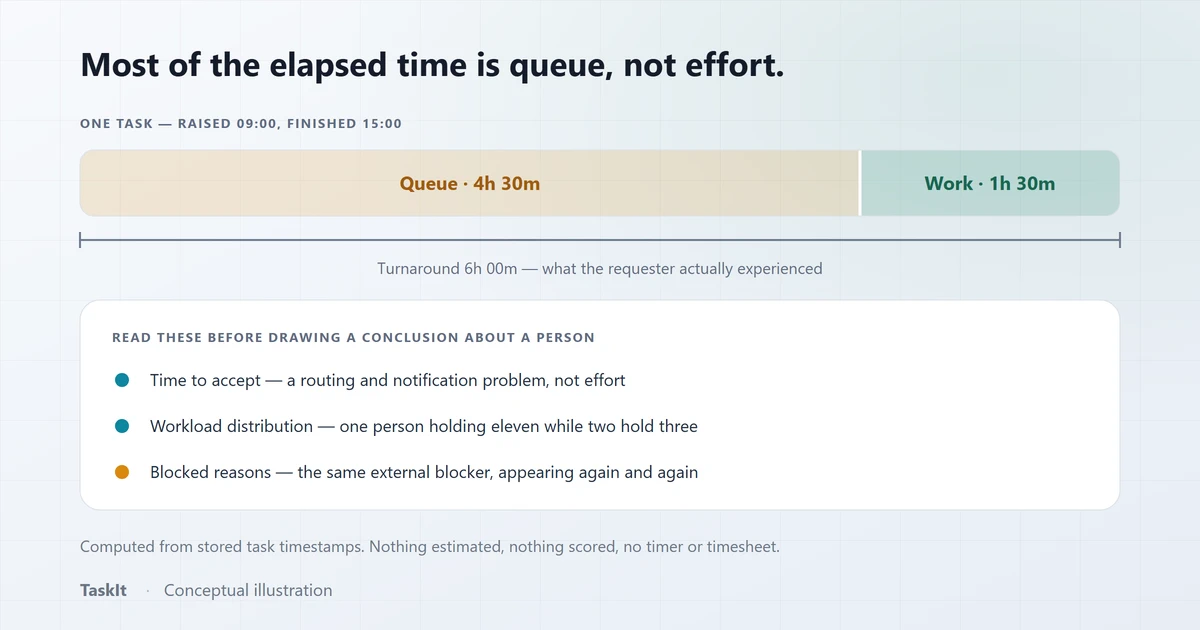
The pair to look at first is completion time against turnaround. If completion is ninety minutes and turnaround is six hours, four and a half of those hours are queue — time nobody was working on it. Pressing people to work faster cannot recover time nobody was working.
These are computed from stored task timestamps in TaskIt’s performance analytics, with nothing estimated or scored, and a duration is only averaged when both ends genuinely exist. A workspace admin chooses which tasks count — self-assigned, recurring, cancelled and blocked tasks, and tasks nobody has picked up, can each be left out — and the 22 built-in reports add filterable lists such as Employee Performance, Workload and Task Timings. Track employee task performance covers the full set and how attribution works.
Check for a queueing problem before anything else
Before you track team productivity as a people problem, check the structure. Most apparent productivity problems in small and mid-sized teams are structural, they have completely different fixes, and none of them involves a conversation about effort.
- Look at time to accept. If it is hours, work is sitting unclaimed. That is a routing or notification failure, not a person failing.
- Look at the gap between completion and turnaround. A large gap is queue. A small gap with a long completion time is genuinely the work itself.
- Look at workload distribution. One person holding eleven tasks while two hold three explains most overdue lists without any reference to anybody’s speed.
- Read the blocked reasons. The same external blocker appearing repeatedly — waiting for a customer, waiting for approval, material not available — is a process problem wearing a performance costume.
The fixes for queueing are structural: route work to a team queue rather than a named person so whoever is free takes it, notify the channel people actually read, and rebalance a queue you can now see. None of them require anyone to work harder, which is why they are the ones to try first.
The counts worth keeping, and the one ratio
A short list of counts describes a person’s situation honestly. Completion rate is the only ratio worth watching, and it needs a minimum sample.
- Pending and in progress. What someone is currently holding. Look at this before adding to it.
- Overdue and blocked. Blocked is the more useful: it is a deliberate statement with a reason attached, not just a date that passed.
- Completed, over a window. Meaningful within one repeated kind of work, misleading across a mixed workload.
- Completion rate. Completed against assigned, with a floor — someone who finished their only task should not outrank someone who finished eighteen of twenty.
Be careful comparing counts between people. They are only comparable when the tasks are comparable in size, which they usually are not. A count describes somebody’s week; it is not a league table position.
Know who the number is actually about
Every per-person figure depends on an attribution rule, and every rule has a blind spot. Knowing yours is the difference between a fair conversation and an unfair one.
The usual rule is to attribute a task to whoever currently holds it. That has one very good property: because a task has at most one current assignee, per-person counts summed across a company can never exceed the company total — which is the invariant a hand-written report eventually breaks.
Its cost is that someone who did most of a job and then handed it on earns nothing, while whoever finished it earns the completion. That is a limitation to compensate for rather than argue away: read handover history alongside the figures, and never open a performance conversation with a per-person average about somebody whose work changes hands frequently.
How to use a number with a person
The purpose of a measurement is to find out what is happening, not to prove a point. If the person cannot see the records behind the figure, do not use the figure.
- Say what you look at, before you look at it. People who do not know acceptance time is being measured will be measured badly for a behaviour nobody asked them to change.
- Show the working. "Your average turnaround is eleven days" is an accusation. "These four tasks account for most of it, and two were blocked on the supplier" is a conversation.
- Ask about the outliers. Averages hide the interesting cases. The three slowest jobs of the month usually contain the actual finding, and it is usually structural.
- Never let the ranking make the judgement. The person at the bottom of a completion-rate ranking is sometimes the one being handed everything difficult, and no formula will tell you that.
Measurement is not monitoring
There is a clear line between recording what happened to the work and recording what a person did at their desk. Crossing it costs more trust than any metric returns.
Screen capture, keystroke logging, idle detection and location tracking measure presence rather than outcomes. They also produce their own distortion: people learn to look busy, which is a skill of no value to anybody.
Task-derived measurement is different in kind. The events being recorded — accepted, updated, handed over, blocked, completed — are things people did to the work, and they were worth recording anyway. TaskIt deliberately has no timer, timesheet, effort log or activity monitor of any kind, which is a design decision rather than a missing feature.
A monthly rhythm that fits in half an hour
Productivity work fails when it is an initiative. It works when it is a short, repeated look at four things.
- Overdue and blocked. Start with what is currently wrong, and read the blocked reasons rather than counting them.
- Workload. Who is holding what. Rebalance before adding anything new.
- Time to accept, per team. The most actionable figure most businesses have, and the one that responds fastest to a structural change.
- The three slowest jobs. Not to attribute them — to find out what they had in common.
Make it arrive
Frequently asked questions
For task-based work, use durations derived from recorded events: how long work waits before someone takes it on, how long it takes once started, and how long the requester waited in total. Read all three together — the difference between the second and third is queue, and queue is usually the largest and most fixable part.
Because it rewards splitting work into more items, which anyone can do within a week of realising it is being counted. Tasks are also rarely comparable in size, so a count across people compares things that are not alike.
Compare completion time with turnaround. If completion is short and turnaround is long, the difference is time nobody was working on it — a queueing problem, fixed by routing work to a team rather than a named person. If completion itself is long, the work or the person’s capacity is the constraint.
No, and it usually makes things worse. Screen capture, keystroke logging and idle detection measure presence and teach people to look busy. Measurements derived from what happened to the work — accepted, progressed, handed over, completed — use events that were worth recording anyway.
A few weeks at minimum, and considerably more before saying anything about an individual. Averages that only include tasks where both timestamps exist are honest about small samples, but a small sample is still a small sample.
Written by
Esha Mehta
All articles by Esha MehtaRelated reading
Articles and pages that cover the next question this one raises.

How to Track Employee Task Performance
Four timestamps produce four measurements. What they tell you about a workflow, what they cannot tell you about a person, and how to read them fairly.
Read article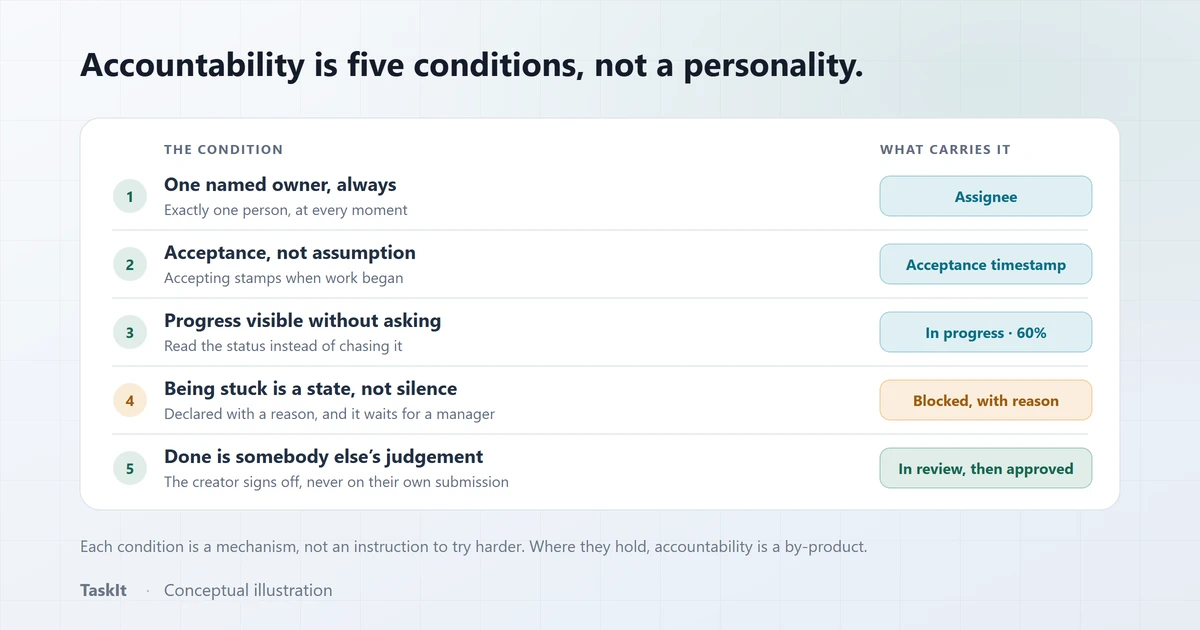
How to Improve Employee Accountability at Work
Why "hold people accountable" fails as an instruction, and the five conditions that make accountability happen without anyone being chased.
Read article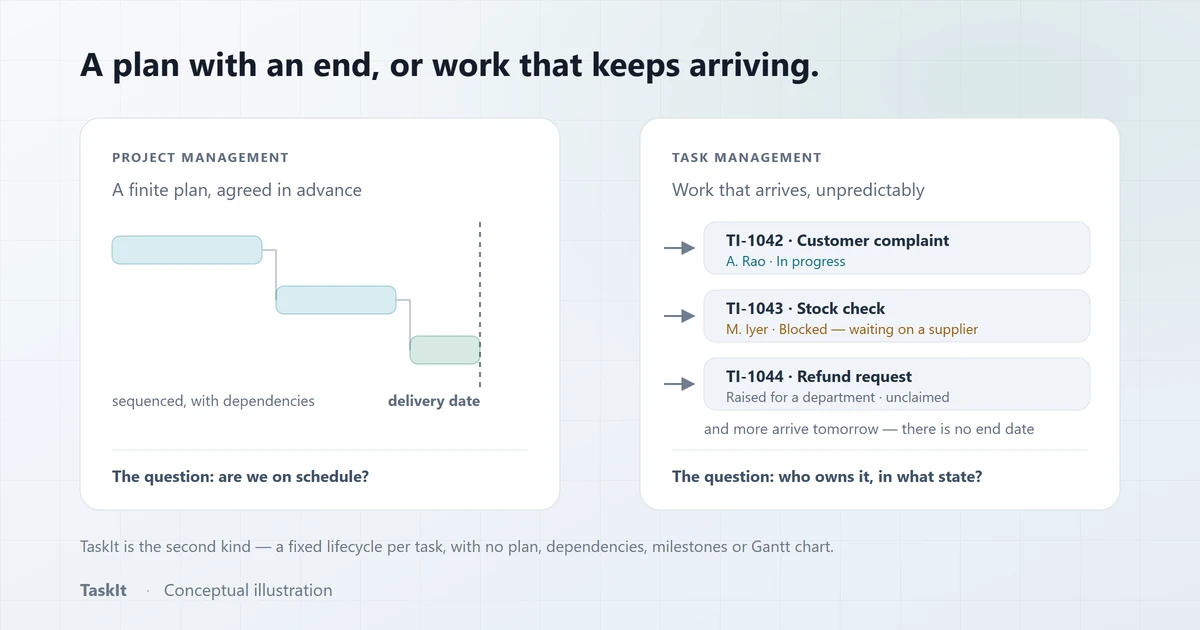
Task Management vs Project Management: Which One Do You Need?
Why Gantt charts and sprints have nothing to say about a complaint that arrived this morning — and how to tell which kind of tool your work actually needs.
Read articleThe employee productivity guide
The long version: what to measure, what to avoid and how to discuss it.
OpenPerformance analytics
The four measurements TaskIt computes, and what they deliberately exclude.
OpenTeam productivity
Attacking queueing, chasing and re-explaining rather than effort.
OpenSee how it works on your own tasks
Every capability described above is available during the 30-day free trial.