Task Management vs Project Management: Which One Do You Need?
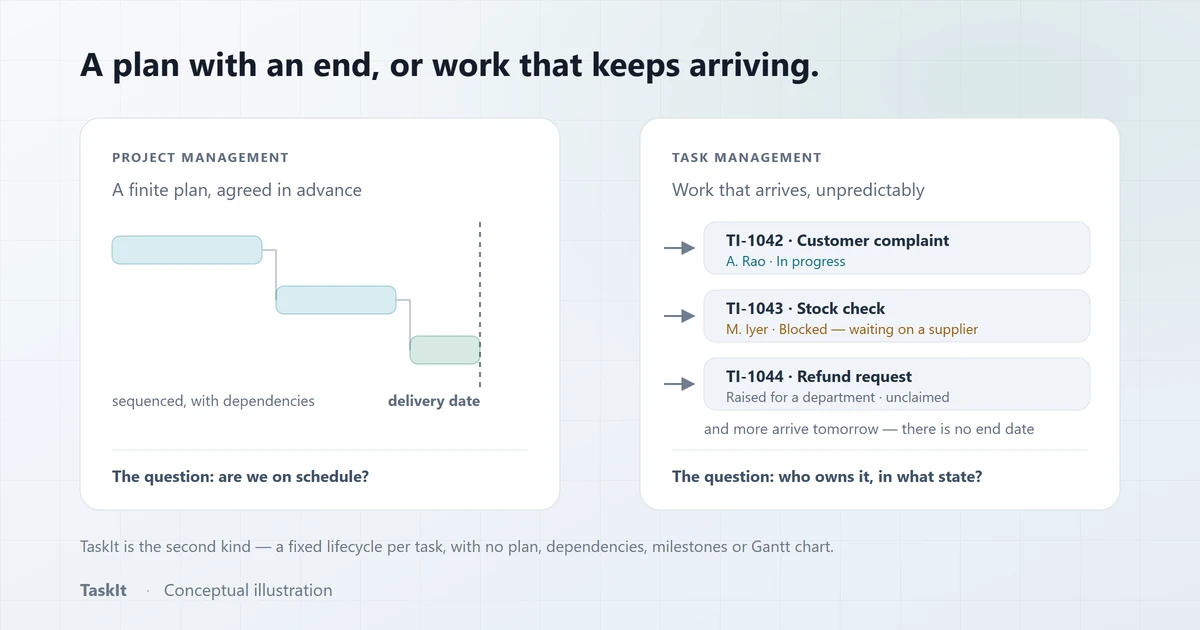
Project management organises a finite body of work towards a defined end date, using a plan, dependencies and milestones. Task management organises continuous work that arrives unpredictably, gets assigned, changes hands and repeats. Most businesses spend most of their week on the second and buy software built for the first, which is why the tool ends up used as an expensive to-do list.
In this article
The difference is whether there is a plan
Not size, not complexity, not how many people are involved. Whether the work was known in advance and has an end.
A project is a finite body of work with a defined outcome and a date by which it is meant to be finished. Because it is finite and known, it can be planned: broken into pieces, sequenced, estimated, and tracked against the plan. Everything distinctive about project management software — Gantt charts, critical paths, milestones, burndown — exists to manage the gap between the plan and reality.
Operational work has no plan because it is not known in advance. A customer complaint arrives on Tuesday. A machine fails on Thursday. A supplier changes their terms. None of it was in anybody’s schedule, and none of it ends — next week brings a different complaint and a different machine.
The test
The same six questions, answered differently
The two categories are not competing. They answer different questions, and a tool designed for one answers the other’s questions badly.
| Project management | Task management | |
|---|---|---|
| Unit of work | A project, broken into tasks | A task, standing on its own |
| Where work comes from | A plan agreed in advance | It arrives, unpredictably |
| When it ends | On the delivery date | It does not |
| The core question | "Are we on schedule?" | "Who owns this and what state is it in?" |
| What sequencing means | Dependencies between tasks | A lifecycle each task passes through |
| What success looks like | Delivered, on time, in scope | Nothing missed, nothing unowned, nothing undocumented |
Why so many businesses buy the wrong one
Because project management is the better-known category, and because the first serious problem a growing business notices looks superficially like a planning problem.
When work starts going missing, the instinct is that there is not enough planning. So a business buys a tool that helps you plan, discovers that nothing about its week fits a plan, and settles into using the project tool as a shared to-do list — paying for a planning engine it never opens.
The symptoms are recognisable:
- One project called "Operations" that never ends and contains four hundred unrelated items.
- Every task at the same level, because the hierarchy the tool wants does not exist in the work.
- Dates that are all wrong, because the tool insists on a start and an end for things that have neither.
- Nobody uses the Gantt view. Not once, after the first week.
- The actual coordination still happens in a chat group, because the tool has no answer to "who is free right now".
What operational work needs instead
Five things, none of which a planning tool is built to provide, and all of which matter more than a schedule for work that has no schedule.
Intake that captures what the work needs
Because work arrives rather than being planned, the moment it arrives is the only chance to capture what it involves. A task form per request type removes three rounds of follow-up questions per job.
Routing without a planner
A project assigns work when the plan is written. Operational work has to be routed as it arrives, often by somebody who does not know who is free — which is why raising it for a team queue works better than naming a person.
A lifecycle rather than dependencies
Operational tasks rarely depend on each other. What they have is a sequence each one passes through — accepted, in progress, possibly handed over or blocked, submitted, reviewed. Enforcing that sequence matters far more than sequencing tasks against one another.
Handling work that changes hands
Leave, shifts and escalations mean operational work moves between people constantly. A recorded handover is the difference between a transfer and a loss of context, and it is not something project tools model at all.
Repetition as a first-class thing
A large share of operational work repeats on a cadence. In a planning tool that is a copied set of items; in a task tool it is a schedule with an execution history that proves each occurrence ran.
When you genuinely do need project management
This is not an argument that project management software is unnecessary. It is an argument for matching the tool to the shape of the work.
Reach for a project tool when all three of these are true:
- The work is finite and known. You can list most of it in advance, even if the list changes.
- Order matters between items. One thing genuinely cannot start until another finishes, and knowing the chain changes decisions.
- There is a date the whole thing is judged against. A launch, a migration, a build, a season.
A software implementation, an office move, a product launch and a construction package are all real projects and deserve real project management. What is worth resisting is the assumption that because those exist, everything else should be modelled the same way.
Many businesses genuinely need both, and run them separately — which is fine. What does not work is running the 90% that is operational inside a tool designed for the 10% that is not.
And where workflow management fits
Between the two, and orthogonal to both: workflow is about whether the order of steps within a piece of work is enforced.
It is easy to confuse workflow management with project management because both involve sequence. The difference is what the sequence is between. A project sequences separate pieces of work against each other; a workflow sequences the stages of one piece of work — raised, approved, executed, checked, closed.
Operational work usually needs workflow and does not need project planning. Task management vs workflow management works through that boundary, which is less obvious than the two names suggest.
How to choose in ten minutes
Take last month rather than a hypothetical. The work you actually did is the specification.
- List twenty things your team did last month. Real items, from a chat thread or a calendar.
- Mark each one: was it in a plan, or did it arrive? The ratio is your answer, and for most businesses it is heavily one-sided.
- For the arrived ones, ask what went wrong. Unowned, unclear, stuck, or self-declared as done? Those are the four failures a task tool addresses.
- For the planned ones, ask whether order mattered. If nothing genuinely blocked anything else, you have a list rather than a project.
- Choose for the majority, not the exception. A rare project can be run in a spreadsheet. Two hundred operational tasks a month cannot.
A shortcut
Frequently asked questions
Project management organises a finite body of work towards a defined end date using a plan, dependencies and milestones. Task management organises continuous work that arrives unpredictably, gets assigned, changes hands and repeats. The distinguishing question is whether the work was known in advance and has an end.
It can, and it usually ends up as an expensive shared to-do list. The planning features go unused because there is no plan, the hierarchy the tool expects does not exist in the work, and the coordination it cannot help with — who is free right now, who owns this, what state is it in — migrates back into a chat group.
Only for the parts of its work that are genuinely projects — a move, a launch, an implementation. The recurring operational work that makes up most weeks needs ownership, routing, handovers, schedules and a record, which is a different category of tool.
Both involve sequence, but of different things. A project sequences separate pieces of work against each other; a workflow sequences the stages within one piece of work — raised, approved, executed, checked, closed. Operational work usually needs the second and not the first.
List twenty things your team did last month and mark each as planned or arrived. Choose for the majority. As a shortcut: "we do not know who is doing what" is a task management problem; "we do not know whether we will make the date" is a project management problem.
Written by
Esha Mehta
All articles by Esha MehtaRelated reading
Articles and pages that cover the next question this one raises.

Task Management vs Workflow Management: What’s the Difference?
The two terms are used interchangeably and mean different things. Definitions, the overlap, and the signals that tell you a team needs workflow structure.
Read article
What Is Task Management? A Complete Guide for Businesses
What task management actually is, the five things every task needs, and the problems that appear when work is tracked in chat instead.
Read article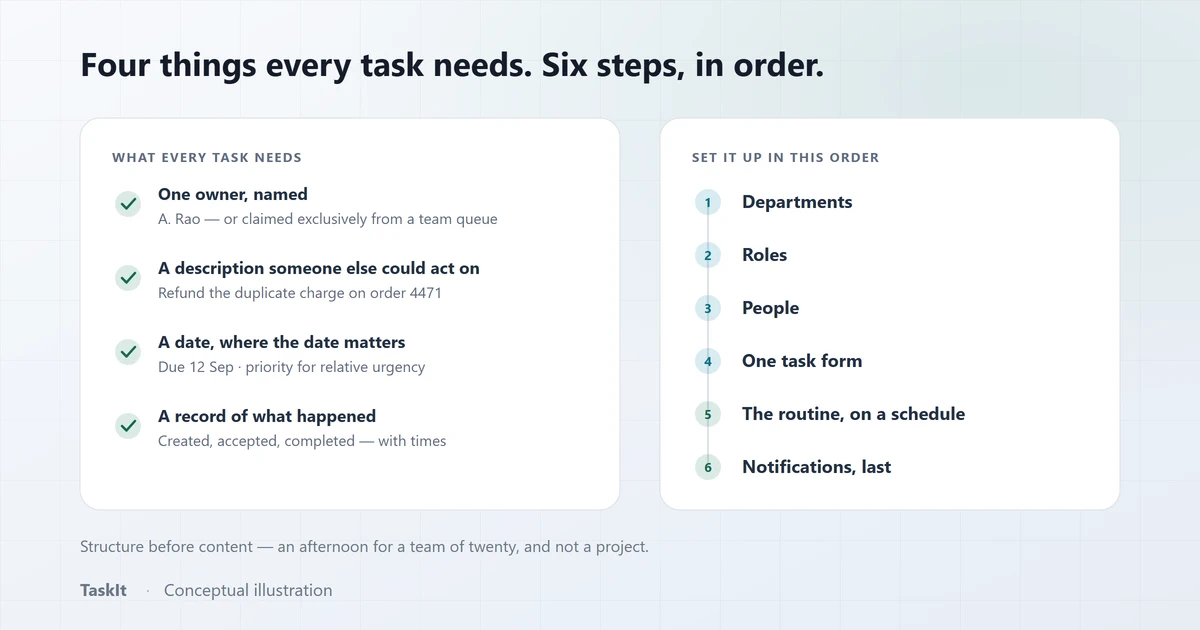
How to Manage Tasks in a Small Business
The moment a small business outgrows one person remembering everything, and the smallest structure that reliably replaces it.
Read articleChoosing task management software
The four kinds of tool in this category, and eight questions to ask in a demo.
OpenBusiness task management
Operational work rather than projects with an end date.
OpenWorkflow management
The lifecycle every task follows, and where TaskIt deliberately stops.
OpenSee how it works on your own tasks
Every capability described above is available during the 30-day free trial.