How to Manage Tasks in a Small Business
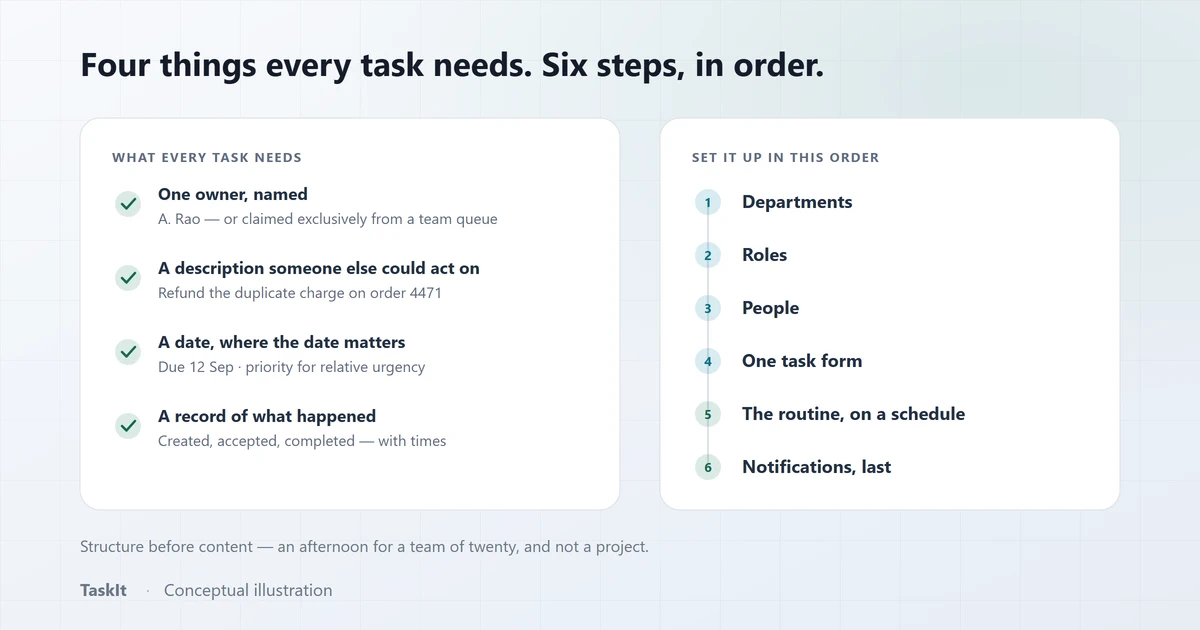
A small business manages tasks well when every piece of work has one named owner, a written description someone else could act on, a date where the timing matters, and a record of what happened. Below about eight people an owner can hold all of that in their head. Past that, the memory becomes the bottleneck and then the risk, and the fix is a small amount of structure introduced in a specific order — not a large system introduced all at once.
In this article
The point at which informal stops working
It is not a headcount so much as a moment: the first time work is missed that everybody assumed somebody else was doing.
Small businesses do not usually decide to introduce task management. They arrive at it after a specific bad week — a customer chased something nobody had started, a routine that had run for two years quietly stopped, or a person left and took a process with them.
The signals are consistent enough to be worth listing, because recognising them early is cheaper than recognising them late:
- Staff ask the owner what to do next. Not because they are unwilling, but because the owner is the only place the answer exists.
- The same question is answered repeatedly. "Which supplier?" and "has this been approved?" get asked every time, because the answer lives in a conversation rather than on the job.
- Nobody can say what is outstanding without opening three chat threads and asking two people.
- Work stops when one person is away. Their absence is not an inconvenience — it is an outage.
- The owner is working evenings on things that are not the business, but the coordination of the business.
Be honest about the other direction
The four things every task needs
Owner, description, date and record. Almost every task-management failure in a small business is one of these four missing.
One owner, named
Work addressed to a group belongs to nobody. That is not a comment on anyone’s character — it is arithmetic. If four people could do it and none was asked, the expected number who start it is somewhere between zero and two, and both outcomes are bad.
The exception is when you genuinely do not know who should take it. Then the answer is not to broadcast it but to raise it for a team in a way somebody can claim exclusively — see department task management.
A description someone else could act on
The test is simple: could a person who was not in the conversation start this within a minute of reading it? "Sort out the Sharma order" fails. "Refund the duplicate charge on order 4471 and email the customer confirming it" passes.
A date, where the date matters
A due date on everything is the same as a due date on nothing. Use dates where something genuinely depends on the timing, and use priority for relative urgency. They answer different questions.
A record of what happened
This is the one small businesses skip and the one they miss most. Three weeks later, a customer disputes a date, a staff member disputes an instruction, or you simply want to know why something took nine days. Without a record, all three become arguments about memory.
Set it up in this order
Structure before content. An hour spent on departments, roles and forms before the first task saves several hours of retrofitting once there are two hundred.
- Departments. Even three or four. They decide who is eligible for which work and how reports group, and creating them afterwards means reassigning everyone.
- Roles. Built from the permissions people actually need. Someone who needs to read reports should get that permission, not an administrator account.
- People. Added individually or imported from a spreadsheet in one pass.
- One task form. For your most common request type. This is the step most small businesses skip and most regret — see custom task forms.
- The routine. Turn the work that repeats into recurring schedules before anyone re-types it manually again.
- Notifications last. Switch them on once there is something worth being notified about, so the first messages people get are useful rather than noise.
For a team of twenty to thirty this is an afternoon, not a project. Treating it as a project — with a steering group, a training day and a phased plan — is itself a risk, because none of that survives a busy week.
Rolling it out without losing the team
Three rules: new work only, keep the channel people already use, and the manager goes first.
Do not migrate anything
The instinct is to move existing work in so everything is in one place. Resist it. A migration is a day of data entry followed by two live systems, and the old one always wins because it already contains everything. Let in-flight work finish where it started and raise only new work in the new system. Within about three weeks the old one is empty by attrition.
Keep WhatsApp, move the record
If your team lives on WhatsApp — and in most small businesses they do — do not ask them to leave. Send task notifications there instead, so the alert arrives where they already read while the state of the work lives on the task. In TaskIt each person can also get one daily WhatsApp list of their own pending tasks, at a time the workspace sets. Task management with WhatsApp covers which events are worth sending.
One rule, announced once
"From Monday, if you want someone to do something, raise it as a task." That one sentence works better than a training session, because everything else can be learned by doing.
The owner has to go first
The fastest way to kill this is for the owner to keep assigning work by message. Staff will correctly conclude the system is optional. The fastest way to secure it is to reply to a verbal request twice with "raise it as a task and I will pick it up".
Getting work off the owner
The real goal is not tidier tasks. It is that the business stops routing everything through one person.
In most small businesses the owner is the routing table. Every incoming request passes through them because they are the only person who knows who is free, who has done it before and what the customer was promised. That works, and it caps the business at whatever one person’s attention can process.
Two changes remove most of it:
- Route work to a team, not a person. A task raised for a department is claimed by whoever is free. The owner no longer has to know who that is.
- Make the state readable. When status, progress and blocked reasons are on the task, checking in becomes reading rather than interrupting — and the reason to route everything through one person disappears.
The second is what makes delegation feel safe enough to keep doing. Task delegation goes into what a properly delegated piece of work actually contains.
What the first month should look like
Four weeks, one change per week, and no numbers until the fourth.
- Week one — raise everything. All new requests become tasks. Nothing else changes. Expect the first tasks to be badly written; that corrects itself.
- Week two — notifications on. Creation and handover alerts to the channel the team reads. This is usually when adoption becomes self-sustaining.
- Week three — forms and schedules. By now you know which questions keep being asked in comments and which requests repeat. Turn the first into fields and the second into schedules.
- Week four — look at the numbers. Overdue work and workload first. Do not draw conclusions about people from four weeks of data; do draw conclusions about queues.
The signal that it is working
Five things not to do
Every one of these is a rollout that failed for reasons that had nothing to do with the software.
| Mistake | Why it fails | Instead |
|---|---|---|
| Import the old spreadsheet | Two live systems; the old one wins | New work only, from an agreed date |
| Make everything Urgent | Priority stops meaning anything | Reserve it for work that displaces other work |
| Give everyone admin access | Nobody can be sure who changed what | Build roles from the permissions actually needed |
| Ban WhatsApp | The channel that works stops working | Keep the channel, move the record |
| Wait until it is perfect | The rollout never starts | One form, one week, then adjust |
Frequently asked questions
Usually somewhere between eight and fifteen, though the trigger is a moment rather than a number: the first time work is missed that everyone assumed someone else was doing, or the first time a second person starts routing work. Below about five people, an owner can genuinely hold the whole operation and the structure will feel like overhead.
Departments, because they decide who is eligible for which work and how reporting groups. Then roles built from real permissions, then people, then one task form for your most common request type. Structure before content — creating departments after adding everyone means reassigning them all.
No. Let work already in flight finish where it started and raise only new work in the new system from an agreed date. A migration produces a day of data entry followed by two live systems, and the old one wins because it already contains everything.
Yes, provided you keep WhatsApp as the notification channel rather than trying to replace it. Send task creation, handover and completion alerts there so work reaches people where they already read, and keep the record — status, progress, history — in the task system where it can be filtered and reported on.
Two changes. Raise work for a team rather than a named person so whoever is free claims it, and make the state of the work readable so checking in becomes reading rather than interrupting. Together they remove most of the reason every request has to pass through one person.
Written by
Esha Mehta
All articles by Esha MehtaRelated reading
Articles and pages that cover the next question this one raises.

What Is Task Management? A Complete Guide for Businesses
What task management actually is, the five things every task needs, and the problems that appear when work is tracked in chat instead.
Read article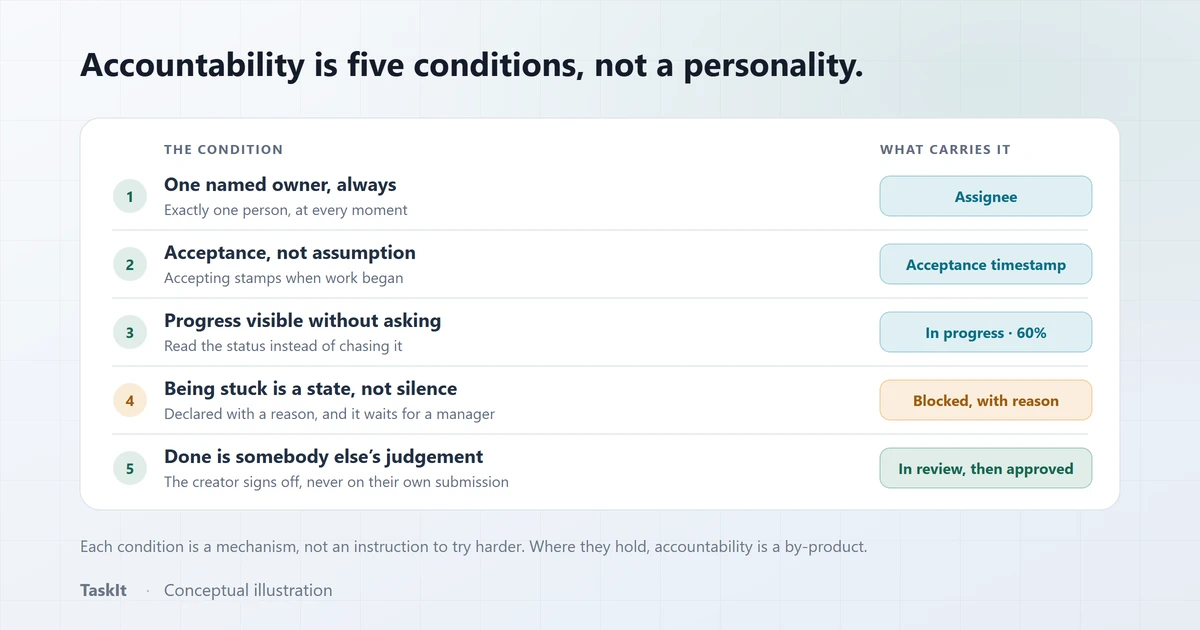
How to Improve Employee Accountability at Work
Why "hold people accountable" fails as an instruction, and the five conditions that make accountability happen without anyone being chased.
Read article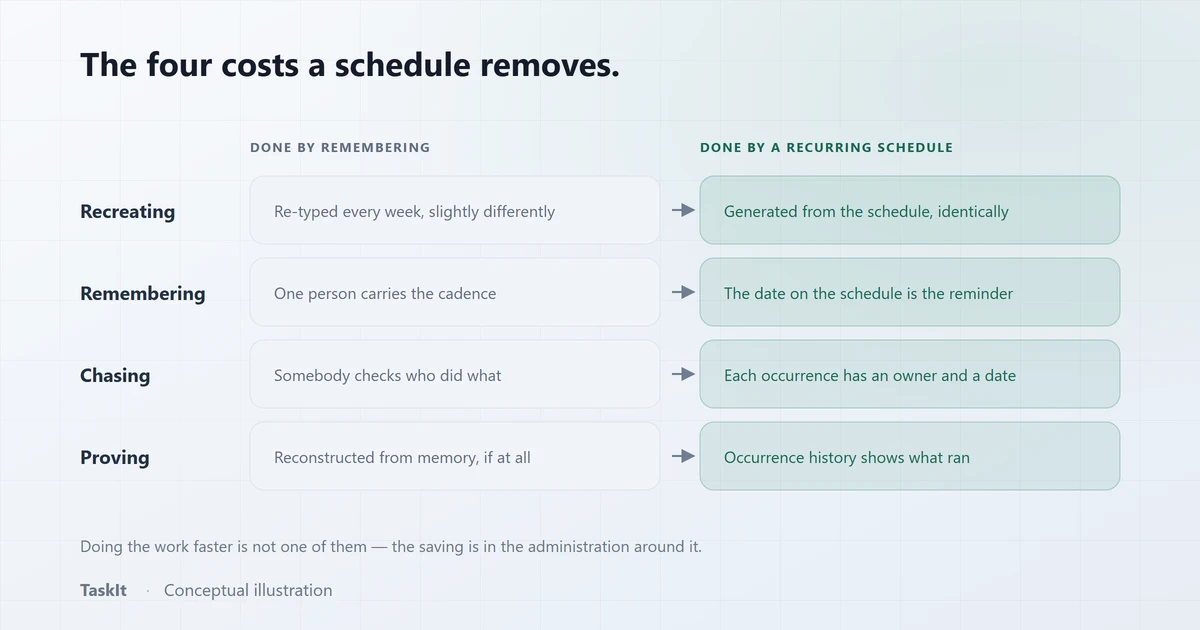
How Recurring Tasks Save Time (and Stop Work Going Missing)
The real cost of repeated work is not doing it — it is the recreating, remembering and proving around it. All three are removable.
Read articleThe task management guide
The full rollout, week by week, including what usually goes wrong.
OpenTaskIt for small businesses
What the first month looks like at ten to fifty people.
OpenTaskIt vs a spreadsheet
Where the tracker sheet stops being enough, and what to keep from it.
OpenSee how it works on your own tasks
Every capability described above is available during the 30-day free trial.